Recycling and Sustainability at Toms Waste
Welcome to the sustainability overview from Toms Waste, where our day-to-day operations are guided by clear environmental targets and practical local action. As Tom's Waste continues to expand services across boroughs, we remain focused on reducing landfill, increasing recycling rates and improving resource recovery. This page outlines our targets, local transfer station roles, charity partnerships, and investments in low-carbon vehicles that help reduce emissions while supporting local circular economy activity.Our Recycling Percentage Target
We have set a measurable target for the coming decade: reach a 70% recycling and recovery rate by 2030 across all municipal and commercial collections we manage. That figure represents materials diverted from landfill through sorting, reuse and energy recovery where appropriate. The objective is aligned with borough waste strategies and national net-zero ambitions; it is both ambitious and achievable thanks to collaboration with councils, businesses and residents.![In a domestic or commercial internal setting, there is a collection of electronic waste and miscellaneous items situated on a clean, neutral-toned floor against a textured stone wall. The electronic waste includes a CRT computer monitor and an older desktop computer tower, both showing signs of age with visible cables and hardware components. Adjacent to these, there is a beige or off-white mechanical keyboard and a black speaker, likely part of the computer setup. Nearby, a small black subwoofer or speaker box and a bundle of tangled cables are also present. To the right, a black desktop tower or server unit with visible cables extends onto the floor, reflecting typical office or home office clutter. On the far left, a traditional wooden broom with natural bristles and a red and yellow handle leans against the stone wall, and in front of it lies a bright pink plastic dustpan. The environment appears uncluttered and well-lit, offering an unobstructed view of the discarded electronic and miscellaneous waste items, which may be targeted for rubbish removal or recycling by local specialists such as Toms Waste in the area near [POSTCODE] or [TOWN].](/pub/_photos/rubbish/f1346961408.jpg) Our approach recognises that local practice matters: many boroughs favour kerbside source separation (glass, paper/card, plastics, food caddies and residual bins) while others operate a mixed dry recycling collection. As TomsWaste works across these different systems, we tailor collections and education to maximise capture of recyclables and organics. We also support seasonal collection changes and trial schemes where boroughs pilot new sorting streams.
Our approach recognises that local practice matters: many boroughs favour kerbside source separation (glass, paper/card, plastics, food caddies and residual bins) while others operate a mixed dry recycling collection. As TomsWaste works across these different systems, we tailor collections and education to maximise capture of recyclables and organics. We also support seasonal collection changes and trial schemes where boroughs pilot new sorting streams.
We support a range of on-the-ground recycling activities that reflect local needs and infrastructure. Examples include:
- Kerbside food waste collection and composting or anaerobic digestion of organic material.
- Dry mixed recycling sorting at consolidation points to improve material quality for reprocessing.
- Separate glass and paper streams where borough policy supports higher-value recovery.
To achieve the recycling percentage target, TOMS WASTE works with local transfer stations to reduce haulage distances and improve material sorting before transport to reprocessors. Our logistics plan uses strategically located transfer points that act as consolidation hubs: they minimise double handling, allow presorting of contaminants and speed materials on to certified recycling facilities. These stations enable us to keep more material in the local circular loop, reducing carbon miles and helping councils meet statutory recycling targets.
![The image displays two large black plastic rubbish bins with closed lids, positioned on a metal frame or trolley outdoors, likely on a driveway or pavement. The bins are situated in front of a wooden fence or paneling, with one bin slightly closer to the viewer on the right and the other behind it. The bins are made of sturdy, smooth, and shiny plastic, with the lids securely fastened, and appear to be set for waste collection or recycling purposes. The environment is well-lit, indicating natural daylight, and there are no visible markings or labels on the bins. The scene suggests a typical domestic or commercial rubbish removal setting, consistent with the waste management services provided by Toms Waste in the UK, particularly around the area of [POSTCODE] or nearby [TOWN]. The focus on the waste containers aligns with sustainable practices highlighted on the 'Recycling and Sustainability' webpage, emphasizing proper waste disposal and recycling efforts.](/pub/_photos/rubbish/f1345125992.jpg)
Partnerships with Charities and Reuse Networks
We partner with local charities and redistribution networks to maximise reuse. Items collected as part of bulky waste or commercial clearances are assessed for repair and reuse; suitable items are diverted to charity partners that support community projects, training programmes and social enterprises. These collaborations mean fewer items are shredded or processed for low-value recovery and more are given a second life, supporting both sustainability and social benefit.Low-carbon vans and a greener fleet are central to our emissions reduction plan. Toms Waste has begun replacing diesel vehicles with low-emission alternatives, including battery electric vans for short urban routes and hybrid models for longer hauls. Our fleet transition roadmap targets 50% low-emission vehicles in urban collections by 2027, with an ongoing replacement programme to electrify or adopt hydrogen-ready technology where practical.
Fleet efficiency goes hand in hand with operational planning: route optimisation software reduces mileage and idle time, while driver training in eco-driving techniques cuts fuel consumption and emissions. For heavy movements between transfer stations and reprocessors we prioritise lower-carbon transport modes and consolidated loads. Tom's Waste publishes annual sustainability summaries detailing fleet improvements and tonne-kilometre reductions, underlining accountability and continual improvement.
Our circular approach spans materials, people and places: we engage borough residents through campaigns to reduce contamination in recycling bins, support schools and community groups in waste reduction activities, and collaborate with local processors to increase the range of materials recycled. We also audit outputs from transfer stations to measure composition, quality and capture rates, using those insights to refine services and reach the 70% recycling target.
At an organisational level, Toms Waste invests in staff training, contractor standards and environmental management systems to ensure consistency across operations. Regular performance reviews and third-party audits help maintain high standards and drive improvements. We emphasise traceability of materials from collection point to final processing, ensuring that recycling claims are robust and that materials are delivered to certified reprocessors whenever possible.
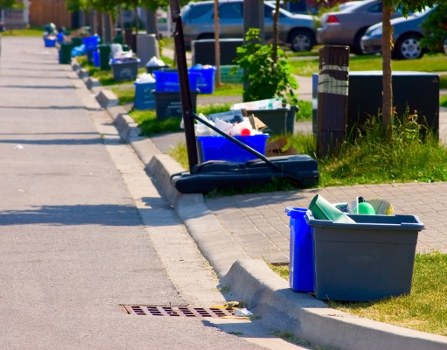 How communities can support our work: while we provide the infrastructure and logistics, success depends on participation. Simple actions by residents and businesses make a large difference:
- Use food caddies and separate organics where provided to reduce contamination of dry recyclables.
- Rinse containers and flatten cardboard to improve sorting efficiency.
- Donate usable items to charity partners rather than sending them for disposal.
 In conclusion, Tom's Waste remains committed to measurable, practical sustainability: hit the 70% recycling and recovery target by 2030, expand low-carbon van adoption, support local transfer stations that improve material quality, and deepen partnerships with charities to enable reuse. By combining local action with efficient logistics and continuous improvement, Toms Waste aims to be a leader in delivering sustainable waste services across boroughs while helping communities keep resources in use for longer.